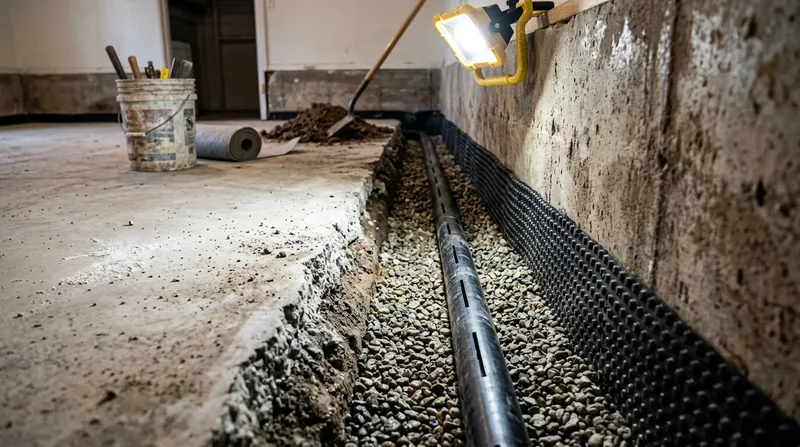




When red Permian clay soaks up a week of spring storms, the water has nowhere to go but down and sideways, and in older Oklahoma City homes with full or partial basements it ends up pressed against the footing and through the wall. An Interior Drain Tile System in Oklahoma City captures that water at the lowest point inside the basement, channels it to a sump basin, and pumps it out before it ever reaches your floor. We install these systems in the brick and stone Tudors and Craftsmans of Heritage Hills, Mesta Park, Crown Heights and Putnam Heights, where 1920s foundation walls and old weeping tile have long since given up. We also work the 1950s to 1970s brick ranches in Midwest City, Del City, Bethany and Moore that sit on slab or partial basements with clay that swells and shrinks with every drought and downpour. If you are tired of a wet basement after every storm, this is the proven answer for the central neighborhoods where hydrostatic pressure is the real problem. Start with a free basement inspection and we will tell you plainly whether drain tile is the right call.
Why Interior Drain Tile Matters in Oklahoma City's Clay and Storm Cycle
Oklahoma City sits on red Permian clay and shale that expands when saturated and contracts in drought, and the metro gets intense spring thunderstorms that dump inches in hours. That combination drives water hard against basement walls and through old brick and stone foundations in the central neighborhoods, where footings were never built for this kind of pressure. Interior drain tile relieves that pressure from the inside, at the footing, which is exactly where the water collects.
- Hydrostatic pressure pushes water through mortar joints and hairline cracks in 1920s brick walls, and interior drain tile intercepts it before it reaches the slab.
- Old clay or cast-iron weeping tile around Heritage Hills and Crown Heights homes collapses or silts up, so the footing drain stops working and water backs up under the floor.
- Spring storms and flash flooding along Bluff Creek and Crutcho Creek raise the water table fast, and a sump basin tied to an interior perimeter drain moves that volume out.
- Drought-to-downpour swings crack parging and open seams, which is why we pair drain tile with basement wall sealing when the walls show efflorescence or seepage.
When you see white efflorescence or a musty smell after rain, the water is already moving through the wall, and drain tile is the fix that addresses the source rather than the symptom.
Key info: A 1928 brick Tudor in Mesta Park with a full basement and a failed clay weeping tile is the classic candidate. After a two-inch spring storm, water wicks through the mortar joints and pools at the slab edge. An interior perimeter drain cut into the slab edge and tied to a sump basin stops the pooling without excavating the yard or disturbing the mature trees.
Permits for drainage work and sump discharge connections vary by jurisdiction, so confirm requirements with the Oklahoma City Development Services before work begins.
How We Install an Interior Drain Tile System in Oklahoma City
We start by walking the basement and the exterior grade, then map where the water is actually entering. In older homes we check the footing depth and the condition of the existing weeping tile, because a drain tile that is still partly working changes the approach. We cut a channel along the interior perimeter, set perforated pipe in washed gravel, and slope it to a sump basin at the low corner. The system is finished with a sump pump, check valve and discharge line that moves water well away from the foundation.
- We inspect the basement, foundation walls and exterior grading to confirm the water source and rule out a simpler crack repair.
- We cut a perimeter channel at the slab edge and remove the old failed drain tile where it exists.
- We install perforated drain tile in a gravel bed with filter fabric, sloped to the sump basin.
- We set the sump basin at the low point and connect a sump pump with a check valve and a discharge line that exits above grade.
- We backfill, patch the slab, and test the system with water before we leave.
Every install ends with a wet test, so you see the water leave the floor and go out the discharge line before we pack up.
Key info: A 1968 split-level in Del City had water crossing the basement floor every time a spring cell stalled over the metro. The original footing drain was silted solid. We cut the perimeter channel, ran new perforated tile to a sump basin, and tied in a battery backup so the pump kept running through a power blip. The floor stayed dry through the next round of storms.
For homes where the exterior grade or downspouts are the bigger contributor, we may recommend French drain installation alongside the interior work.
Interior Drain Tile Approaches We Use in the Oklahoma City Metro
Not every basement gets the same system. The right approach depends on footing depth, wall material, whether the slab is structural, and how much water the site takes. Here is how we match the method to the house.
| Approach | Description | Best for |
|---|---|---|
| Full interior perimeter drain | Continuous perforated tile cut into the slab edge around the entire basement, sloped to one sump basin. | Older full basements in Heritage Hills, Mesta Park and Crown Heights with wall seepage on multiple sides. |
| Partial perimeter drain | Drain tile along the wet wall or walls only, tied to a sump basin at the low corner. | Homes where water enters on one side, often the uphill or creek-facing wall. |
| Drain tile plus wall membrane | Interior perimeter drain combined with dimple board or a vapor barrier on the wall to manage moisture. | Brick and stone walls with efflorescence, damp mortar or a persistent musty smell. |
| Drain tile plus sump and backup | Interior drain tied to a primary sump pump with a battery backup and check valve. | Homes that lose power during spring storms and cannot risk a flooded basement. |
| Drain tile repair and replacement | Replacing failed or silted existing interior drain tile and re-grading to the sump basin. | Basements where a prior system was installed but no longer moves water. |
We size the pipe and the basin to the water volume the site actually sees, not to a one-size template.
Interior Drain Tile System Cost in Oklahoma City: What to Expect
Most interior drain tile work in the Oklahoma City metro starts around $50 per linear foot, and that figure moves with footing depth, wall material, slab thickness and how much old tile has to come out. A single-wall partial system on a 1950s ranch in Midwest City lands near the low end, while a full perimeter in a 1920s brick basement with a failed weeping tile and a sump upgrade runs higher. Access matters too: a basement with a finished ceiling or a tight stairwell takes more labor than an open one.
We quote from the linear footage we actually measure, not from a phone estimate, and we separate the drain tile from the sump pump and backup so you can see what each piece costs. Get two or three estimates and compare what is included, because a low number that skips the gravel bed, filter fabric or wet test is not the same system. Our pricing overview lays out the ranges we work from.
Key info: A 60-linear-foot partial perimeter in a Moore ranch with a shallow footing can start near $50 per linear foot, while a 90-linear-foot full perimeter in a Nichols Hills basement with a deep footing and a sump and battery backup runs well above that. The footage and the footing depth drive the number, not the neighborhood.
Finding an Interior Drain Tile System Contractor Near Me in Oklahoma City
You want a contractor who specializes in below-grade water, not a general handyman who also does foundations. Ask for the license and insurance certificate, get two or three written estimates that itemize the drain tile, gravel, sump and discharge, and ask for references from basements similar to yours. Confirm who pulls any permit for drainage or sump discharge work, and check with your HOA before any exterior discharge line changes the grade or the look of the yard.
Ask specifically how they handle the discharge line and whether they test the system with water before they leave. A contractor who cannot explain hydrostatic pressure and the difference between an interior and an exterior fix is not the right call for a wet basement. Reach out through our contact page and we will schedule a look at your basement.
Interior Drain Tile System in Oklahoma City: Pricing Guide
| Service | Price | Details |
|---|---|---|
| Partial perimeter drain tile | Starting at $50/linear ft | Includes channel cut, perforated tile, gravel bed, filter fabric and tie-in to sump basin. |
| Full perimeter drain tile | Starting at $65/linear ft | Continuous interior perimeter drain around the full basement, sloped to a single sump basin. |
| Drain tile with sump and backup | Starting at $85/linear ft | Interior drain tied to a primary sump pump, check valve, discharge line and battery backup. |
| Drain tile repair and replacement | On estimate | Scope depends on how much old tile must be removed and re-graded, so an on-site look comes first. |
| Travel | Included | in Oklahoma City and surrounding areas, no separate call-out or mileage fee |
| Estimate | Free | Response within 24h at (405) 536-6341, no obligation to book |
Indicative pricing, the exact cost depends on square footage, finish, and site access. Free personalized estimate within 24h at (405) 536-6341.


